Featured Posts

Highlights – Warriors 2 v Hallam (3 Nov 09)

Final score: Warriors 2 (13) v Hallam (9)


Highlights – Warriors 3 v Lions (1 Nov 09)

Final score: Warriors 3 (15) v Lions (5)


EKA – league tables and results

You can keep up-to-date with how each of our teams is getting on in their respective leagues by following the links to the English Korfball Association website below:

Highlights – Man City v Warriors 1 (25 Oct 09)

Final score: Manchester City (7) v Warriors 1 (17)


Fixtures and training times

Training times and fees

During the winter months,  we train at South Trafford College, Timperley, Manchester (website), every Wednesday at 20:00-21:30. 

Fees

If you are interested in playing for Manchester Warriors, you can either choose to pay a monthly membership fee or pay-as-you-play.

Our monthly membership fee is currently £25 per month (£20 for students and the unemployed). Whilst this sum may seem high at first glance, it covers all training sessions and games within that month. You can pay the aforementioned fees by direct debit or by cheque.

If you would prefer to pay-as-you-play, the fees are £5 per training session and £6 per game (£4 and £5 respectively for students and the unemployed).

Home games

Our home games are usually held at Manchester Velodrome (website) or at Manchester Health Academy (website) on Sunday afternoons.

Where possible, we try to ensure that all our teams play at the same venue on the same day, to increase support and participation.

Away games

Our first team play in CEKL 1 and all of their away games take place within a 75 mile radius of Manchester. We arrange transport to and from the games where possible.

Our second team play in CEKL 2 and play all of their away games within a 50 mile radius of Manchester. Again, we arrange transport where possible.

Our third team play in NWKL and all of their games are local.

As well as participating in league matches, Manchester Warriors attend tournaments at home and abroad throughout the year. We also enter the EKA Cup, as well as inter-area and Counties competitions.

Any team related questions should be aimed at any of the team manager s who will endeavour to help. They are

Fixtures – 2009/10 season

Please note that the times below are subject to change.

First team

Second team


Third team


Playing the game

As with any sport, the rules of korfball are updated from time-to-time, but these are the basic rules on which korfball is based.

The field of play

When played indoors, korfball should be played on a 40m x 20m rectangular pitch, although in England the pitch size can vary from between venues, due to the sizes of sports halls and is generally roughly the size of a standard netball court. When played outdoors, the pitch should be 60m x 30m.

The pitch is divided into two halves (one for “attack” and one for “defence”), with a goalpost being located near the backline of each half. A “penalty spot” is located 2.5m in front of each post.

Match length

The length of a match can vary depending on whether it is a single league game or one of many at a day tournament, but in any case matches must not last longer than 2 x 30 minutes (with up to a fifteen minute interval).

Equipment

As mentioned above, a goalpost is located near the backline of each half. These goalposts each support a cylindrical “korf” (literally the Dutch for “basket”) and the korf is positioned slightly higher than the baskets used in basketball and netball. The korf is generally made of either plastic or wicker. There is no backboard.

The ball used during games is a similar size to a football, although it is slightly heavier.

Teams

Each team has eight players, comprising four men and four women.  Two men and two women from each team occupy each of the halves in “divisions.”

Each division either attacks or defends, depending on their starting role. Each team has a captain responsible for communicating with the referee. After every two goals, the players switch zones and change roles: defenders become attackers and vice versa.


At half time, there is a change of ends.  Each team can make two substitutions per game.

By way of example, imagine that the pitch is split into two halves (1) and (2). Initially, Team A may have four players “attacking” in half 1 and four defending in half 2, with Team B similarly having four players “defending” in half 1 and four “attacking” in half 2. When two goals are scored (at any side), Team A’s attackers will switch halves and become defenders (moving to half 2) and its defenders will become attackers (moving to half 1).

Playing the game and scoring

Korfball consists almost entirely of passing the by hand from person to person. Dribbling (bouncing) the ball is not permitted. Once a player catches the ball, they cannot run with it, however they are allowed to rotate on the spot, using one leg (which must not move) as a “pivot,” much like in basketball once a player has “lost their dribble.”

Passing and movement form the basis of the game, with attackers using a combination of tactics and changes of speed/direction to lose the defenders in order to create a shooting chance and score a goal. This is not as easy as it sounds, because an attacker is not allowed to shoot if their defending player is nearer to the post than the attacker and within arm’s length of them (see “Defending Shots” below).

A goal is scored when the ball passes completely through the korf. Any player in the attacking division may score. The team that scores the most goals wins the match. When one team’s attacking division scores, the other team’s attacking division restarts the game.

Marking the opposition

Korfball is a non-contact sport. When marking/defending, players from each division will generally pair up with a player of a similar standard, height etc. from the other team’s division. Players may only mark a player of the same sex. Like in netball, a player may shadow and mark their opponent closely provided that they do not (a) make contact with them; and (b) hinder them excessively (see “Fouls” below).

Shooting and defending shots

To be able to shoot, an attacker must break free from their defending, typically by (a) losing their defender and shooting over them (a “distance shot”); or (b) running past their defender, catching a pass from a team-mate and then shooting on the run (a “running-in shot” – similar to a basketball “lay-up”). Players can improvise and can shoot however they choose.

Defending shots in korfball is slightly different than defending shots in netball and basketball. In addition to actually “blocking” the ball when facing the attacker (from the front only), a shot will only be “defended” when the following three conditions are satisfied:

  • the defender is facing the attacker and can touch their torso without leaning forward (”within arm’s length”); and
  • the defender must try to block the ball; and
  • the defender must be nearer to the post than the attacker.


An attacker cannot shoot if they are “defended,” even if it appears that the defender would not be able to block the ball if the attacker chose to shoot (i.e. due to height difference). A shot taken while an attacker is “defended” results in a free pass to the defending team.

Defending an attacker of the opposite sex who would otherwise be free gives away a penalty to the attacking team (see “Penalties” below). Also, making contact with the attacker whilst they are attempting an running-in shot will result in a penalty. If the defender is between the attacker and the basket when the attacker begins his running-in shot, if the defender stands his/her ground, the shot will be defended.

Fouls

Whilst this list is not exhaustive, broadly speaking, during the game it is prohibited to:

  • touch the ball with leg or foot;
  • hit the ball with the fist;
  • take hold of the ball whilst in a fallen position;
  • run with the ball;
  • partake in “solo play” (i.e. passing to one’s self);
  • hand the ball to another play of your team;
  • delay the game unnecessarily;
  • knock the ball out of an opponent’s hand;
  • make (deliberate) physical contact with an opponent;
  • hinder an opponent in possession of the ball excessively;
  • hinder an opponent of the opposite sex in throwing the ball;
  • hinder someone who is already being hindered by another opponent (i.e. double team);
  • play in attack when defending and vice versa;
  • shoot from a defender position (see above);
  • influence a shot my moving the post;
  • take hold of the post when running, jumping or in order to move away quickly;
  • violate the conditions laid down for a free pass or penalty;
  • shoot, as a defender, from the defending half;
  • shooting after “cutting” past another attacker (i.e. running so close to a fellow attacker that the defender collides with or is likely to collide with the attacker, thereby giving up his defending position); and
  • shoot when one plays without a personal opponent (in situations where one team is a man down).

Penalties

Penalties are awarded when a foul results in the loss of a scoring chance (or for repeated infringements which improperly hinder the attack). The “penalty spot” is located 2.5m in front of each post. A player taking a penalty shot can shoot however they choose, however many players prefer the “underarm” technique.

The person taking the penalty cannot touch the ground between the penalty spot and the post, before the ball has left their hands.


Until the ball has left the hands of the shooter, the other players must observe a distance of 2.5m in all directions from the shooter, following which they can position themselves in order to collect a rebound (if applicable).

Free passes

A free pass occurs after a foul, generally where a foul is committed that does not result in the loss of a scoring chance. The free pass is taken from the spot where the infringement is committed. Players must stand 2.5m from the player taking the free pass and the pass must be taken within four seconds of the referee’s whistle. Whilst a goal may not be scored directly from a free pass, there are techniques to create a scoring opportunity when taking free passes from the penalty spot.

If an opposing player moves before the ball is passed, the process will restart. Repeated infringements may result in a penalty to the attacking team. If the pass is not taken within four seconds, a free pass will be awarded to the other side.

Korfwhat?!

A (very brief) history of korfball

As a sport, korfball can be described as a non-contact hybrid of netball and basketball. It was invented in the early twentieth century by a Dutch schoolteacher, Nico Broekhuysen, who wished to design a mixed-sex sport based on a simple premise – equality. In short, he envisaged a sport where men and women were able to compete in the same game on an equal footing, irrespective of physical (and to some extent, athletic) advantages.

Since its creation, the sport has spread from Holland all over the world – with countries such as Britain, Germany, Spain and the USA all having their own national leagues and tournaments. The International Korfball Federation (IKF) is recognised by the International Olympic Committee and is a member of the Association of Recognised IOC International Sports Federation and International World Games Association.


You can read a BBC interview with Warriors’ own Amy Dickens on “Korf and Effect” here.

Major events in the korfball calendar include the World Championships (every four years – the next one taking place in 2011), European Championships (every four years – the next one taking place in October 2010) and the Europa Cup for Champion Clubs (held annually). There are also youth team World and European Championships every four years, as well as additional national and international events.

In Great Britain, whilst the majority of clubs are based in South London, there are leagues and clubs operating all over the country and many participate in either local/regional leagues or the National League, which is comprised of teams from the major regional leagues, such as the Midlands and North West.

Korfball in thirty seconds

A play a game of korfball, you need two teams of four men and four women. The court is divided into two halves – with a “division” from each team playing in each half. A “division” comprises two men and two women from each team. One team’s division will start the game attacking in one half or defending in the other. The other team will do the opposite. Play as follows: (1) pass and move; (2) without dribbling; (3) with no contact; with a view to (4) shooting and scoring. You cannot shoot if your opponent is closer to the basket than you and can touch your chest. Switch halves every two goals (attackers become defenders and vice versa). Two thirty (or less) minute halves. The team with the most goals at the end of the game wins. Post-drink beers to celebrate/commiserate. Simple.

Who are we?

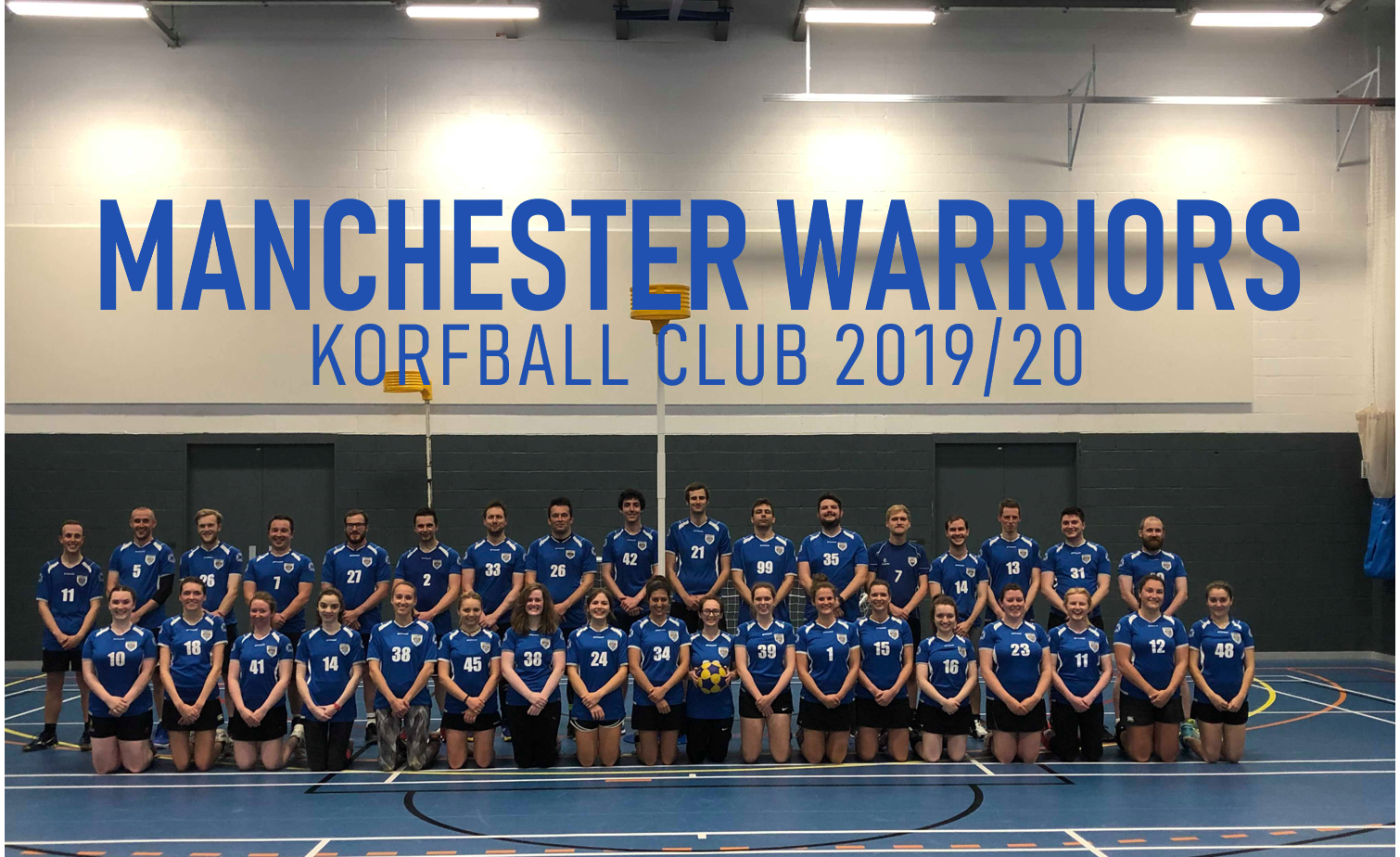
Manchester Warriors Korfball Club was established in 2006.  Despite being a relatively new club, we now have already grown to two teams and hoping to establish a 3rd team this season. All teams compete throughout the year in regional league matches and at national indoor and outdoor tournaments (during the winter and summer seasons respectively).

Our first team currently compete in the CEKL Division 1  league, to which they were promoted in 2007 , and our second team, having previously competed in the North West league, were recently promoted to the CEKL Division 2 league at the close of the 2008/09 season.  On top of this, as a club we have won a number of tournaments and have competed in tournaments in Europe.

We do not prescribe to a “one size fits all” approach and our squad includes players of all standards, shapes and sizes.  As a club, we pride ourselves on catering for all types of players and we have ex-international players playing alongside people who have never played team sports before, as well as with basketball and netball players who fancied a change and have never looked back.

Whether you are a sports enthusiast looking for a new challenge or someone that simply wants to meet new people and enjoy our regular socials, you are more than welcome to join us.  We do not expect you to know anything whatsoever about korfball, so there is no need to be shy.  Come along to a training session and have a go!

You can also find us on:


Facebook Twitter

Under construction

Welcome to the shiny new Manchester Warriors Korfball Club website.

As you can see, the website is currently a work-in-progress, so please bear with us during this initial “live testing” period.  We aim to have the site 100% up and running in no time at all, so make sure that you bookmark www.manchesterwarriors.co.uk and come back soon!

UG12661UG12742